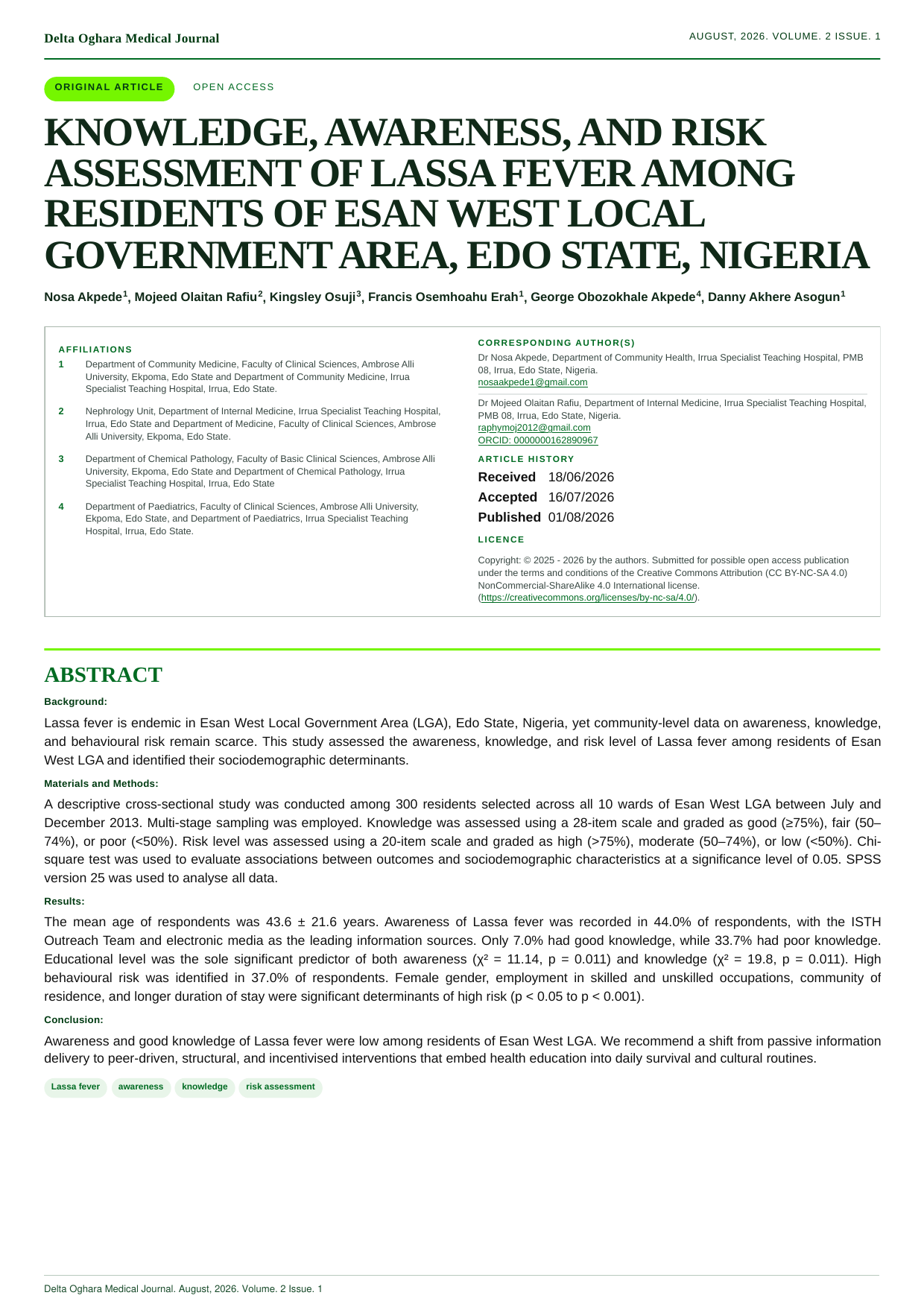
KNOWLEDGE, AWARENESS, AND RISK ASSESSMENT OF LASSA FEVER AMONG RESIDENTS OF ESAN WEST LOCAL GOVERNMENT AREA, EDO STATE, NIGERIA
Keywords:
Lassa fever, awareness, knowledge, risk assessmentAbstract
Background: Lassa fever is endemic in Esan West Local Government Area (LGA), Edo State, Nigeria, yet community-level data on awareness, knowledge, and behavioural risk remain scarce. This study assessed the awareness, knowledge, and risk level of Lassa fever among residents of Esan West LGA and identified their sociodemographic determinants.
Materials and Methods: A descriptive cross-sectional study was conducted among 300 residents selected across all 10 wards of Esan West LGA between July and December 2013. Multi-stage sampling was employed. Knowledge was assessed using a 28-item scale and graded as good (≥75%), fair (50–74%), or poor (<50%). Risk level was assessed using a 20-item scale and graded as high (>75%), moderate (50–74%), or low (<50%). Chi-square test was used to evaluate associations between outcomes and sociodemographic characteristics at a significance level of 0.05. SPSS version 25 was used to analyse all data.
Results: The mean age of respondents was 43.6 ± 21.6 years. Awareness of Lassa fever was recorded in 44.0% of respondents, with the ISTH Outreach Team and electronic media as the leading information sources. Only 7.0% had good knowledge, while 33.7% had poor knowledge. Educational level was the sole significant predictor of both awareness (χ² = 11.14, p = 0.011) and knowledge (χ² = 19.8, p = 0.011). High behavioural risk was identified in 37.0% of respondents. Female gender, employment in skilled and unskilled occupations, community of residence, and longer duration of stay were significant determinants of high risk (p < 0.05 to p < 0.001).
Conclusion: Awareness and good knowledge of Lassa fever were low among residents of Esan West LGA. We recommend a shift from passive information delivery to peer-driven, structural, and incentivised interventions that embed health education into daily survival and cultural routines.
Downloads
References
World Health Organisation. Lassa fever [Internet]. 2024. Available from: https://www.who.int/news-room/fact-sheets/detail/lassa-fever
Agbonlahor DE, Akpede GO, Happi CT, Tomori O. 52 Years of Lassa Fever Outbreaks in Nigeria, 1969–2020: An Epidemiologic Analysis of the Temporal and Spatial Trends. Am J Trop Med Hyg. 2021 Oct 1;105(4):974. doi:10.4269/AJTMH.20-1160 PubMed PMID: 34460421.
Monath TP. A short history of Lassa fever: the first 10–15 years after discovery. Curr Opin Virol. 2019 Aug 1;37:77–83. doi:10.1016/J.COVIRO.2019.06.005 PubMed PMID: 31323506.
Amifofum OS, Ogunsumi D, Awosanya E, Icomiare A, Evbuomwan K, Balogun MS, et al. Spatial analysis of confirmed Lassa fever cases in Edo State, Nigeria, 2008 - 2014. PAMJ-OH 2021; 5:11. 2021 Jun 29;5(11). doi:10.11604/PAMJ-OH.2021.5.11.24710
Al-Mustapha AI, Adesiyan IM, Orum TG, Ogundijo OA, Lawal AN, Nzedibe OE, et al. Lassa fever in Nigeria: epidemiology and risk perception. Sci Rep. 2024 Dec 1;14(1):27669. doi:10.1038/S41598-024-78726-3 PubMed PMID: 39532966.
Bonwitt J, Sáez AM, Lamin J, Ansumana R, Dawson M, Buanie J, et al. At Home with Mastomys and Rattus: Human-Rodent Interactions and Potential for Primary Transmission of Lassa Virus in Domestic Spaces. Am J Trop Med Hyg. 2017;96(4):935. doi:10.4269/AJTMH.16-0675 PubMed PMID: 28167603.
Uppala PK, Karanam SK, Kandra NV, Edhi S. Lassa fever: A comprehensive review of virology, clinical management, and global health implications. World J Virol. 2025 Sep 25;14(3):108405. doi:10.5501/WJV.V14.I3.108405 PubMed PMID: 41025087.
Reyna RA, Littlefield KE, Shehu N, Makishima T, Maruyama J, Paessler S. The Importance of Lassa Fever and Its Disease Management in West Africa. Viruses 2024, Vol 16, Page 266. 2024 Feb 7;16(2):266. doi:10.3390/V16020266 PubMed PMID: 38400041.
Abiodun OP, Abiodun-Omogoye FA. Measuring knowledge, attitudes, and practices in Lassa fever prevention: A cross-sectional survey from Kailahun and Kenema Districts, Sierra Leone. Journal of Interventional Epidemiology and Public Health. 2025 Aug;8:AbstractELIC2025165 (Poster 143). doi:10.37432/JIEPH-CONFPRO5-00287
Dolopei D, Amo-Addae M, Adewuyi P, Wilson H, Shannon F, Lawubah J, et al. Knowledge, attitudes and practices (KAP) regarding Lassa fever disease among adults in endemic and non-endemic Counties of Liberia, 2018: A Cross-sectional study. Journal of Interventional Epidemiology and Public Health. 2021 Jun 6;4(2). doi:10.37432/jieph.supp.2021.4.2.01.9
Saka SA, Ojo DO, Mezu NM, Uzuegbu CO, Ighodaro O, Illoh OO, et al. Knowledge, perception and preventive practices of Lassa fever among mothers of under-five children in an endemic community in Edo State, Nigeria. BMC Public Health. 2025 Dec 1;25(1):837. doi:10.1186/S12889-025-22057-Z PubMed PMID: 40033294.
Alenoghena I, Omuemu V. Knowledge and Risk Factors of Lassa Fever among Household Members in a Rural Community in Edo State, Southern Nigeria. Ibom Medical Journal. 2021 Jul 1;14(3):296–309. doi:10.61386/IMJ.V14I3.51
Tomori O, Fabiyi A, Sorungbe A, Smith A, McCormick JB. Viral hemorrhagic fever antibodies in Nigerian populations. Am J Trop Med Hyg. 1988;38(2):407–10. doi:10.4269/AJTMH.1988.38.407 PubMed PMID: 3128130.
Olowookere SA, Adegbenro CA, Idowu A, Omisore AG, Shabi OM, Ikem UR, et al. Knowledge, Attitude and Practices Toward Lassa Fever Control and Prevention Among Residents of Ile-Ife, Southwest Nigeria. Int Q Community Health Educ. 2017 Jan 1;37(2):107–12. doi:10.1177/0272684X17701261 PubMed PMID: 28511600.
Tobin EA, Asogun D, Happi C, Ogbaini E, Gunther S. Risk factors for Lassa fever in endemic communities of Edo State, Nigeria. International Journal of Infectious Diseases. 2014 Apr 1;21:258–9. doi:10.1016/j.ijid.2014.03.958
Sudirman. The Role of Health Literacy in Improving Health Outcomes: Challenges, Interventions, and Policies. Journal of Health Literacy and Qualitative Research. 2022 Mar 31;2(1):15–30. doi:10.61194/JHLQR.V2I1.530
Wiedermann CJ, Barbieri V, Lombardo S, Gärtner T, Rina P, Eisendle K, et al. Health Information Use and Trust: The Role of Health Literacy and Patient Activation in a Multilingual European Region. Int J Environ Res Public Health. 2025 Apr 1;22(4):570. doi:10.3390/IJERPH22040570/S1 PubMed PMID: 40283795.
Oruganti P, Root E, Ndlovu V, Mbhungele P, Van Wyk I, Berrian AM. Gender and zoonotic pathogen exposure pathways in a resource-limited community, Mpumalanga, South Africa: A qualitative analysis. PLOS Global Public Health. 2023 Jun 1;3(6):e0001167. doi:10.1371/JOURNAL.PGPH.0001167 PubMed PMID: 37276220.
Published
Issue
Section
Categories
License
Copyright (c) 2026 Delta Oghara Medical Journal

This work is licensed under a Creative Commons Attribution-NonCommercial-ShareAlike 4.0 International License.
This work is licensed under the Creative Commons Attribution-NonCommercial-ShareAlike 4.0 International License (CC BY-NC-SA 4.0). You are free to share and adapt the material for non-commercial purposes, provided appropriate credit is given to the author(s) and Delta Oghara Medical Journal, a link to the licence is provided, and any adapted material is distributed under the same licence.
Licence link: