Utility of NT-proBNP in the Diagnosis of Heart Failure Phenotypes in a Sub-Saharan African Population
Keywords:
N-terminal pro-B-type Natriuretic Peptide, Heart Failure, Diagnosis, Phenotypes, Sub-Saharan Africa, Echocardiography, BiomarkerAbstract
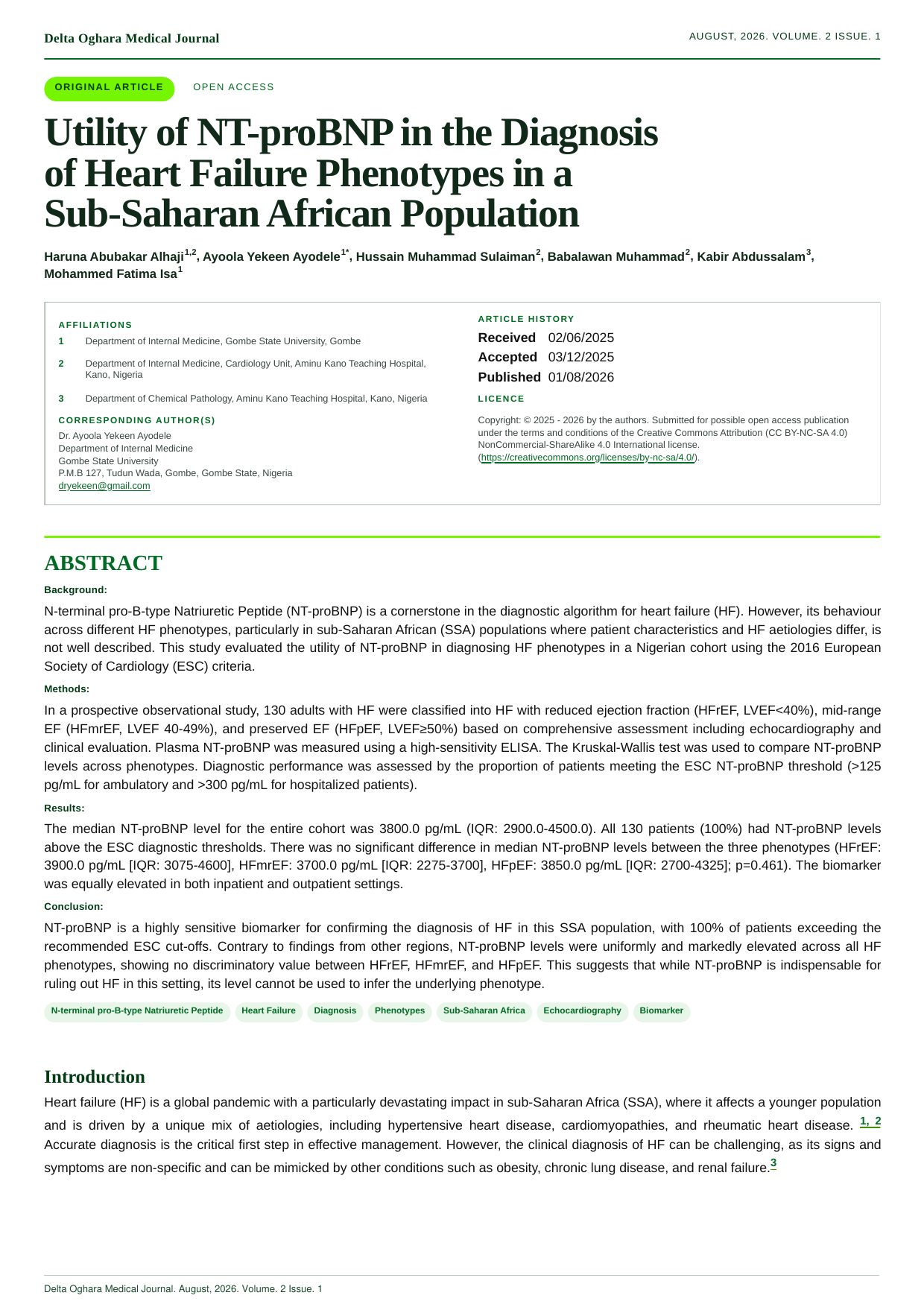
Background: N-terminal pro-B-type Natriuretic Peptide (NT-proBNP) is a cornerstone in the diagnostic algorithm for heart failure (HF). However, its behaviour across different HF phenotypes, particularly in sub-Saharan African (SSA) populations where patient characteristics and HF aetiologies differ, is not well described. This study evaluated the utility of NT-proBNP in diagnosing HF phenotypes in a Nigerian cohort using the 2016 European Society of Cardiology (ESC) criteria.
Methods: In a prospective observational study, 130 adults with HF were classified into HF with reduced ejection fraction (HFrEF, LVEF<40%), mid-range EF (HFmrEF, LVEF 40-49%), and preserved EF (HFpEF, LVEF≥50%) based on comprehensive assessment including echocardiography and clinical evaluation. Plasma NT-proBNP was measured using a high-sensitivity ELISA. The Kruskal-Wallis test was used to compare NT-proBNP levels across phenotypes. Diagnostic performance was assessed by the proportion of patients meeting the ESC NT-proBNP threshold (>125 pg/mL for ambulatory and >300 pg/mL for hospitalized patients).
Results: The median NT-proBNP level for the entire cohort was 3800.0 pg/mL (IQR: 2900.0-4500.0). All 130 patients (100%) had NT-proBNP levels above the ESC diagnostic thresholds. There was no significant difference in median NT-proBNP levels between the three phenotypes (HFrEF: 3900.0 pg/mL [IQR: 3075-4600], HFmrEF: 3700.0 pg/mL [IQR: 2275-3700], HFpEF: 3850.0 pg/mL [IQR: 2700-4325]; p=0.461). The biomarker was equally elevated in both inpatient and outpatient settings.
Conclusion: NT-proBNP is a highly sensitive biomarker for confirming the diagnosis of HF in this SSA population, with 100% of patients exceeding the recommended ESC cut-offs. Contrary to findings from other regions, NT-proBNP levels were uniformly and markedly elevated across all HF phenotypes, showing no discriminatory value between HFrEF, HFmrEF, and HFpEF. This suggests that while NT-proBNP is indispensable for ruling out HF in this setting, its level cannot be used to infer the underlying phenotype.
Downloads
References
Damasceno A, Mayosi BM, Sani M, Ogah OS, Mondo C, Ojji D, et al. The causes, treatment, and outcome of acute heart failure in 1006 Africans from 9 countries: Results of the sub-Saharan Africa survey of heart failure. Arch Intern Med. 2012;172(18):1386-94.
Bloomfield GS, Barasa FA, Doll JA, Velazquez EJ. Heart failure in sub-Saharan Africa. Curr Cardiol Rev. 2013;9(2):157-73.
Kelder JC, Cramer MJ, van Wijngaarden J, van Tooren R, Mosterd A, Moons KGM, et al. The diagnostic value of physical examination and additional testing in primary care patients with suspected heart failure. Circulation. 2011;124(25):2865-73.
Maisel AS, Krishnaswamy P, Nowak RM, McCord J, Hollander JE, Duc P, et al. Rapid measurement of B-type natriuretic peptide in the emergency diagnosis of heart failure. N Engl J Med. 2002;347(3):161-7.
Daniels LB, Maisel AS. Natriuretic peptides. J Am Coll Cardiol. 2007;50(25):2357-68.
Ponikowski P, Voors AA, Anker SD, Bueno H, Cleland JGF, Coats AJS, et al. 2016 ESC Guidelines for the diagnosis and treatment of acute and chronic heart failure. Eur Heart J. 2016;37(27):2129-200.
Bettencourt P. NT-proBNP and BNP: biomarkers for heart failure management. Eur J Heart Fail. 2004;6(3):359-63.
Mehra MR, Uber PA, Park MH, Scott RL, Ventura HO, Harris BC, et al. Obesity and suppressed B-type natriuretic peptide levels in heart failure. J Am Coll Cardiol. 2004;43(9):1590-5.
Dokainish H, Teo K, Zhu J, Roy A, AlHabib KF, ElSayed A, et al. Heart Failure in Africa, Asia, the Middle East and South America: The INTER-CHF study. Int J Cardiol. 2016;204:133-41.
Lubien E, DeMaria A, Krishnaswamy P, Clopton P, Koon J, Kazanegra R, et al. Utility of B-natriuretic peptide in detecting diastolic dysfunction: comparison with Doppler velocity recordings. Circulation. 2002;105(5):595-601.
Tschöpe C, Kasner M, Westermann D, Gaub R, Poller WC, Schultheiss HP. The role of NT-proBNP in the diagnostics of isolated diastolic dysfunction: correlation with echocardiographic and invasive measurements. Eur Heart J. 2005;26(21):2277-84.
Iwanaga Y, Nishi I, Furuichi S, Noguchi T, Sase K, Kihara Y, et al. B-type natriuretic peptide strongly reflects diastolic wall stress in patients with chronic heart failure. J Am Coll Cardiol. 2006;47(4):742-8.
Karaye K, Saidu H, Yahaya I, Bala M. Prevalence, clinical characteristics and outcome of pulmonary hypertension among admitted heart failure patients. Ann Afr Med. 2013;12(4):197-204.
Lang RM, Badano LP, Mor-Avi V, Afilalo J, Armstrong A, Ernande L, et al. Recommendations for cardiac chamber quantification by echocardiography in adults: an update from the American Society of Echocardiography and the European Association of Cardiovascular Imaging. Eur Heart J Cardiovasc Imaging. 2015;16(3):233-70.
Yancy CW, Jessup M, Bozkurt B, Butler J, Casey DE, Colvin MM, et al. 2017 ACC/AHA/HFSA Focused Update of the 2013 ACCF/AHA Guideline for the Management of Heart Failure: A Report of the American College of Cardiology/American Heart Association Task Force on Clinical Practice Guidelines and the Heart Failure Society of America. Circulation. 2017;136(6):e137-e161.
Januzzi JL, Camargo CA, Anwaruddin S, Baggish AL, Chen AA, Krauser DG, et al. The N-terminal Pro-BNP investigation of dyspnea in the emergency department (PRIDE) study. Am J Cardiol. 2005;95(8):948-54.
McMurray JJ, Packer M, Desai AS, Gong J, Lefkowitz MP, Rizkala AR, et al. Angiotensin-neprilysin inhibition versus enalapril in heart failure. N Engl J Med. 2014;371(11):993-1004.
Solomon SD, Rizkala AR, Gong J, Wang W, Anand IS, Ge J, et al. Angiotensin Receptor Neprilysin Inhibition in Heart Failure with Preserved Ejection Fraction: Rationale and Design of the PARAGON-HF Trial. JACC Heart Fail. 2017;5(7):471-82.
Masson S, Latini R, Anand IS, Barlera S, Angelici L, Vago T, et al. Direct comparison of B-type natriuretic peptide (BNP) and amino-terminal proBNP in a large population of patients with chronic and symptomatic heart failure: the Valsartan Heart Failure (Val-HeFT) data. Clin Chem. 2006;52(8):1528-38.
Kerkelä R, Ulvila J, Magga J. Natriuretic Peptides in the Regulation of Cardiovascular Physiology and Metabolic Events. J Am Heart Assoc. 2015;4(10):e002423.
Sliwa K, Hilfiker-Kleiner D, Petrie MC, Mebazaa A, Pieske B, Buchmann E, et al. Current state of knowledge on aetiology, diagnosis, management, and therapy of peripartum cardiomyopathy: a position statement from the Heart Failure Association of the European Society of Cardiology Working Group on peripartum cardiomyopathy. Eur J Heart Fail. 2010;12(8):767-78.
Gerber IL, Stewart RA, Legget ME, West TM, French RL, Sutton TM, et al. Increased plasma natriuretic peptide levels reflect symptom onset in aortic stenosis. Circulation. 2003;107(14):1884-90.
Wang TJ, Larson MG, Levy D, Benjamin EJ, Leip EP, Wilson PW, et al. Impact of obesity on plasma natriuretic peptide levels. Circulation. 2004;109(5):594-600.
Shah SJ, Kitzman DW, Borlaug BA, van Heerebeek L, Zile MR, Kass DA, et al. Phenotype-specific treatment of heart failure with preserved ejection fraction: a multiorgan roadmap. Circulation. 2016;134(1):73-90.
Published
Issue
Section
Categories
License
Copyright (c) 2026 Delta Oghara Medical Journal

This work is licensed under a Creative Commons Attribution-NonCommercial-ShareAlike 4.0 International License.
This work is licensed under the Creative Commons Attribution-NonCommercial-ShareAlike 4.0 International License (CC BY-NC-SA 4.0). You are free to share and adapt the material for non-commercial purposes, provided appropriate credit is given to the author(s) and Delta Oghara Medical Journal, a link to the licence is provided, and any adapted material is distributed under the same licence.
Licence link: